



What is the difference between electrical current, voltage, and power? What is grounding? What is a residual current device (RCD) used for? When is a Consuel certificate required? All the answers to your questions are provided in this practical glossary on electricity: an index containing all the vocabulary used by our professionals in the IZI by EDF network for electrical work!
A – B – C – D
Electrical equipment – DCL box – DTI box – Electrical circuit – Communication box – Electricity meter – Consuel certificate – Day/night contactor – Alternating current – Direct current – Leakage current – Electric current – Short circuit – Electrical diagnostics – Main circuit breaker – Branch circuit breaker / Fuse – Electrical distribution – Terminal block
E – F – G – H
Electrification – Electrocution – Electrical wire – Technical housing duct – Modular clock
I – J – K – L
Switch – Residual current switch – Electrical current – Transfer switch – Equipotential bonding
M – N – W – P
Electrical upgrades – Electrical safety upgrades – Grounding – Surge protectors – Power outlets – Modular outlets – RJ45 outlets – Electrical power
Q – R – S – T
Electrical resistance – Electrical panel – Sub-panel – SELV – Remote switch – Dimmer – Voltage
Key concepts in electricity
Electric current : Electric current is a physical phenomenon defined by the transfer of free electrons in a conductive body; this movement is made possible by the presence of an electromagnetic field. An electric current can be compared to the current of a river. Electric current is measured in volts (V), the reference unit.
Alternating current : also called sinusoidal current, alternating current changes direction at regular intervals, called cycles. It can travel long distances without energy loss. This type of current, used in France to power homes, operates using transformers distributed throughout the power grid. Alternating current is controllable and adapts to users' needs (particularly domestic needs).
Direct current (DC) : This is a current that flows in only one direction, regularly, with a constant intensity. On a small scale, direct current is characteristic of closed-circuit equipment (batteries, for example). However, its path over long distances is difficult to control; it is also responsible for energy losses.
Electric current intensity : Current intensity corresponds to the quantity of electric charge over time (or current flow) at a given point. The ampere (A) is the unit of measurement specific to the intensity of an electric current. We can again use the metaphor of a river and its flowing water.
Voltage : Voltage refers to the electrical quantity measured between two terminals of a component. Voltage also refers to the flow of current in a circuit between the live and neutral conductors . Voltage differs between alternating current (AC) and direct current (DC) . The standard voltage in France, as in most European countries, is 230 volts.
Safety extra low voltage: also called TBS , is a voltage range with an autonomous, doubly insulated power supply, used especially at home for lighting damp rooms (bathroom, shower room).
Electrical power : corresponds to the electrical energy exchanged, given or received, by a body per unit of time. The power produced or consumed is measured in Watts (W) or, in the context of your electricity consumption, in kilowatt-hours (kWh).
Electrical resistance : represents the force that a conductor exerts to oppose the flow of current. It is measured in Ohms (Ω).

Electrical work done safely, IZI! I'm starting my project
The basics of electrical renovation
Electrical compliance upgrades involve strictly adhering to the NF C 15-100 electrical standard (grounding, new circuits and electrical panel, compliant equipment, installation of a technical distribution board, a communication box, and RJ45 sockets, etc.). Compliance upgrades are mandatory for all new housing. For renovating the electrical system of an older (or at least existing) dwelling, the focus is more on bringing it up to code.
Electrical safety upgrades : the work included in a safety upgrade complies with the minimum requirements of NF C 15-100 in 6 compliance points. The safety upgrade essentially corresponds to the minimum electrical safety requirements:
- Presence of a main electrical installation disconnect device
- Presence of at least one differential device suitable for the earth connection
- A circuit breaker is present for each electrical circuit.
- Presence of an equipotential bonding connection in premises equipped with a drain or a bathtub
- Absence of outdated electrical equipment (bare wires, torn-out power outlets, etc.)
- Protection of electrical wires by conduits, baseboards or moldings.
Electrical renovation work in existing (and often older) homes is also frequently referred to as bringing electrical systems up to code according to NF C 15-100 . This involves adapting to the standard's requirements to completely rewire and protect electrical circuits, replace the electrical panel, and ensure the correct number of devices (switches, sockets, etc.).
Grounding : This refers to a safety device installed in the vast majority of homes (at a minimum in bathrooms and kitchens, and in all rooms of most newer dwellings). Grounding involves diverting leakage currents to the earth via a grounding rod, grounding conductors (ground wires), a grounding terminal block, and equipotential bonding to protect against insulation faults. Several techniques can be used to ground a home: installing a ground rod, a ground loop in the foundation trench, or a conductor in a trench.
Electrical safety inspection: This mandatory document for the sale or rental of a property aims to assess the condition of the electrical installation in a property over 15 years old. The inspection is included in the list of mandatory documents to be attached to the deed of sale or lease agreement (technical diagnostic file). Its purpose is to inform prospective tenants or buyers of any risks and deficiencies in the existing electrical installation. However, the inspection is not legally binding and cannot mandate any electrical work.
Consuel : refers both to the organization responsible for certifying electrical installation compliance (the National Committee for the Safety of Electricity Users) and to the electrical compliance certificate itself. In practical terms, the Consuel certificate is a CERFA form required by the party carrying out the electrical work, and is mandatory for:
- Connect all new electrical installations to the public electricity grid
- Bringing the dwelling up to standard or making it safe as part of a renovation, once the installation has been switched off by the electricity distribution network operator (Enedis)
- Set up a system to produce one's own electricity

The key elements of an electrical installation
Technical housing duct : also known as a GTL, this refers to a support structure that connects (from the floor or ceiling) all control panels and electrical safety devices. It is essentially a column that groups the incoming and outgoing connections of an electrical panel, a main circuit breaker, an electricity meter, and a communication box. The GTL is only mandatory in new dwellings, installed at a suitable height and accessible to all (according to the requirements of NF C 15-100).
Although the two concepts are similar, be careful not to confuse the GTL (Technical Housing Panel) with the ETEL (Electrical Technical Space of the Dwelling). The ETEL is the space reserved for electrical power and communication equipment. The GTL, however, is included within the ETEL.
Electricity meter: If you have no prior knowledge of electricity , recognizing your electricity meter shouldn't be a problem. The meter (Linky, for example) measures the electricity consumed in your home in kilowatt-hours (kWh). This meter is owned by the electricity distribution network operator (Enedis in most cases in France). It can be installed directly inside your home (especially in detached houses) or outside (in the lobby of an apartment building).
Main circuit breaker: also called an EDF circuit breaker or service disconnect, this small box marks the limit of intervention for the electricity distribution network operator. It is defined by both the NF C 14-100 and NF C 15-100 standards. Installed upstream of the electrical panel or, in rarer cases, at the property line, its role is to protect you and the entire electrical installation by cutting off the power to the home in the event of work being carried out or if electricity consumption exceeds your contracted limit.
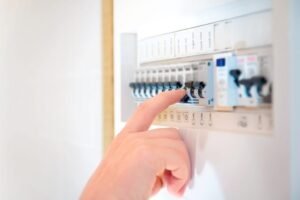
An electrical panel, also called a distribution board (or main distribution board for building-wide electrical distribution systems with risers ), is a box typically installed in the entrance of a dwelling. It houses all the protective devices for the electrical circuits in your home (residual current devices, circuit breakers, specific modules). Its role is to protect and easily identify the circuits (lights, power outlets, cooktops, radiators, etc.). It is also the heart of an electrical installation, as the panel connects all the electrical distribution in a dwelling.
Deux principaux types de tableau électrique sont installés à domicile : le monophasé ou le triphasé. Le type monophasé est le plus répandu dans les habitations de l’hexagone. Il est adapté aux besoins domestiques et quotidiens : le chauffage et l’éclairage, les équipements électroménagers, la recharge d’un véhicule électrique… Le type triphasé est lui destiné à alimenter des appareils électriques puissants et énergivores : four à pain, machines-outils… En d’autres termes, tout l’arsenal d’une entreprise ou unité de production.
Tableau divisionnaire : porte également le nom de tableau secondaire, désignant un tableau supplémentaire venant compléter l’installation électrique principale. Le tableau divisionnaire n’a pas vocation à se substituer au tableau principal mais à renforcer l’installation de base lorsque le tableau principal est sous-dimensionné ou pour distribuer l’électricité dans un nouvel espace éloigné du tableau principal (par exemple pour alimenter un local de piscine en extérieur, ou pour une extension…).
Circuit électrique : désigne un ensemble de fils électriques conducteurs et de composants (de type interrupteurs, prises de courant, lampes, appareils électroménagers…) parcourus par un courant électrique. Un logement comporte généralement un circuit dédié à l’éclairage, un circuit dédié aux prises de confort, au chauffage, au ballon d’eau chaude, ou encore des circuits spécifiques à la salle de bain, aux appareils électroménagers (réfrigérateur, plaques de cuisson, machine à laver, lave-vaisselle…).
Fil électrique : le fil est est composé d’une gaine (enveloppe isolante en plastique par exemple) et d’un ou de plusieurs brins en cuivre, matériau conducteur. Son rôle est de conduire l’électricité dans vos circuits. Les fils électriques sont présents partout dans votre logement, néanmoins camouflés par des plinthes ou moulures, couverts par vos appareillages ou dissimulés dans la structure du logement.
Domino : il s’agit d’un dispositif qui relie plusieurs fils électriques entre eux pour assurer la conductivité du courant dans les fils électriques. On parle aussi de bornes Wago : des sortes de dominos à leviers et à plusieurs entrées, plus simples d’utilisation que les dominos classiques. Avec les Wago, les tournevis sont inutiles et la manipulation semble simplifiée.
Appareillage électrique : les appareillages ne sont autres que les interrupteurs pour allumer et éteindre la lumière, les prises de courant et les boîtiers DCL pour un éclairage sécurisé et pratique à utiliser.
Prise de courant : cet appareillage se compose d’une prise mâle en mesure de recevoir une prise femelle. La prise de courant transmet alors le courant électrique à un appareil branché. On parle de prise de courant avec terre (2P+T) dès lors qu’une broche de terre permet d’évacuer les courants de fuite vers la terre.
Interrupteur : il commande (ferme et ouvre) notamment vos circuits d’éclairage et autorise le passage du courant. On distingue les interrupteurs simples des interrupteurs va-et-vient (contrôle depuis au moins deux endroits dans une pièce). Plusieurs modèles sont enfin disponibles sur le marché : interrupteurs à bouton-poussoir, interrupteurs à effleurement, interrupteurs crépusculaires…
Boîtier DCL : le dispositif de connexion luminaire (DCL) permet de brancher et de débrancher les luminaires au plafond ou appliques murales facilement et en toute sécurité. Ces boîtiers sont obligatoires pour les logements neufs.
Coffret de communication / VDI : cette installation spécifique et obligatoire dans les logements neufs crée un environnement multimédias voix, données & images (VDI) pour assurer une bonne connexion Internet entre autres, dans une habitation. Le coffret de communication est constitué d’un boîtier DTI et de prises Ethernet facilitant le câblage de votre box Internet et reliant un réseau en étoile de prises RJ45 dans les pièces de votre logement.
Boîtier DTI : désigne un dispositif de terminaison intérieur reliant le réseau téléphonique public au réseau téléphonique de votre domicile. Le boîtier test, présent dans votre coffret de communication, peut à juste titre être utilisé par votre fournisseur ou opérateur téléphonique pour tester votre ligne en cas de problème. On distingue deux types de boîtiers DTI : le DTI en T pour les anciennes prises de téléphone, le DTI format RJ45 pour les logements plus récents (depuis 2008) et le DTIo pour les logements équipés de la fibre optique.
Prises RJ45 : ce type de prise permet de raccorder un ordinateur notamment à une box Internet sans même utiliser le réseau Wi-Fi. Le réseau Ethernet permet une connexion rapide et performante à Internet. Dans les logements les plus récents ou intégralement rénovés selon la NF C 15-100, on retrouve les prises RJ45 dans le salon et dans les chambres.
Inverseur de source : désigne un système permettant de basculer la source principale d’électricité vers une source secondaire en cas de dysfonctionnement (panne de courant par exemple) ou par souci de préservation de l’installation électrique (capacités et puissance). On pense notamment aux maisons subissant à répétition des pannes de courant en milieu rural. On pense également aux dispositifs de recharge électrique ou de production de chauffage importante et énergivore (pompe à chaleur par exemple) à mettre en marche en alternance…
Equipotential bonding : This is a device that cancels out voltage differences and conducts current to earth in case of contact with metallic elements. It eliminates any risk of electrocution for occupants who handle metal door and window frames, touch a metal pipe, or a metal bathtub, for example. A distinction is made between the main equipotential bonding (which applies to the entire dwelling) and the local or secondary equipotential bonding (which applies to each room of the dwelling).
Electrical distribution: This refers to what is also called the electrical network or wiring; in other words, all the electrical cables for your circuits running from the distribution board. The distribution can be surface-mounted : the cables run in moldings, trunking, or baseboards fixed to the floors, walls, and ceiling. The distribution can also be recessed , meaning integrated into your walls, floors, and ceilings via chases. The electrical wires are invisible, covered by a protective layer. This method is preferred in new construction. Finally , semi-recessed installation is a middle ground, ideal for electrical renovation projects. The wiring is partially recessed and partially surface-mounted in trunking.
Electrical work done safely, IZI! I'm starting my project
The typical composition of an electrical panel
Residual current circuit breaker (RCCB) : a module installed at the beginning of the row in the electrical panel. The switch consists of a lever that drops instantly and cuts off the electricity in the event of a leakage current problem (intensity difference) or direct contact with live current. It is therefore essential for personal protection. Two types of RCCBs are generally installed in homes: type A and type AC. Type A is reserved for high-energy appliances (cooktops, washing machines, electric vehicle charging points). Type AC is more suitable for lower-energy circuits (lights, power outlets, for example).
Branch circuit breaker or fuse : a module installed along a row of circuit breakers in a distribution board. These safety devices protect your electrical circuits against overcurrents and short circuits. Each circuit must have appropriate protection, as specified by standard NF C 15-100: for example, a 32A circuit breaker for cooktops, a 20A circuit breaker for a water heater, and a 16A circuit breaker for standard outlets. Unlike a fuse, which self-destructs, a circuit breaker can be reset once the fault has been cleared.
Surge protector : a specific module installed in the electrical panel, mandatory in certain French departments with a high risk of thunderstorms. The surge protector (not to be confused with a lightning rod) acts as its name suggests, blocking lightning strikes to protect your electrical system from power surges.
Day/night contactor : a specific module installed in the electrical panel, optional. The contactor allows you to connect and control the operation of certain energy-intensive appliances at night during off-peak hours (if you have a peak/off-peak electricity subscription): washing machine, water heater, etc. This module is particularly useful for saving energy.
Modular timer : a specific module installed in the electrical panel that defines the start and stop times for your home's electrical appliances, particularly energy-intensive ones (heating, washing machine, dishwasher, water heater, etc.). The timer can replace the day/night contactor. The idea is to be able to program your home's heating schedule without necessarily having a peak/off-peak electricity subscription.
Remote switch : a module installed in the electrical panel that allows you to customize the lighting in your home from multiple locations. In other words, the remote switch allows you to control a lamp from several switches.
Remote dimmer switch : a module installed in the electrical panel that allows you to adjust the light intensity in your home using a dial instead of a traditional switch, or a push button. The remote dimmer switch is convenient for adjusting the lighting to suit the desired ambiance (soft lighting, cozy atmosphere, etc.) or the time of day (morning, late afternoon, evening, etc.). This gadget also helps save energy in the process.
Modular socket : This power outlet is installed directly on the electrical panel, or within the GTL (Technical Housing Panel). It allows you to connect any type of device during electrical renovation work or a permanent internet box, which would be connected to the communication panel.

Electrical hazards
Short circuit: refers to a connection between two points of electrical potential; an electrical hazard that can cause material and/or bodily damage.
Leakage current : refers to a current that flows through the conductors of a circuit or a metallic component. Leakage current is caused by faulty insulation or moisture, and results in a loss of electrical charge. It can be dangerous to people and justifies the presence of residual current devices (RCDs) and grounding systems (grounding the dwelling).
Electrocution : This is the state of an electrified body, that is, a body charged with electricity. Electrocution is the passage of an electric current through the human body. The consequences can sometimes be very serious: burns, trauma, tetany, asphyxiation…
Electrocution : a more serious form of electric shock that can lead to the death of the person affected (cardiac arrest, fatal asphyxiation, for example). Electrocution depends on several factors, including the duration of exposure to the electric discharge, the resistance of the human body, the voltage (measurable with a multimeter ), the type of current, etc.
Electrical work done safely, IZI! I'm starting my project

Marine, Web Editor
As a Web Editor at IZI by EDF, my mission is to offer you quality and up-to-date content on charging devices for electric vehicles and electrical renovation work.